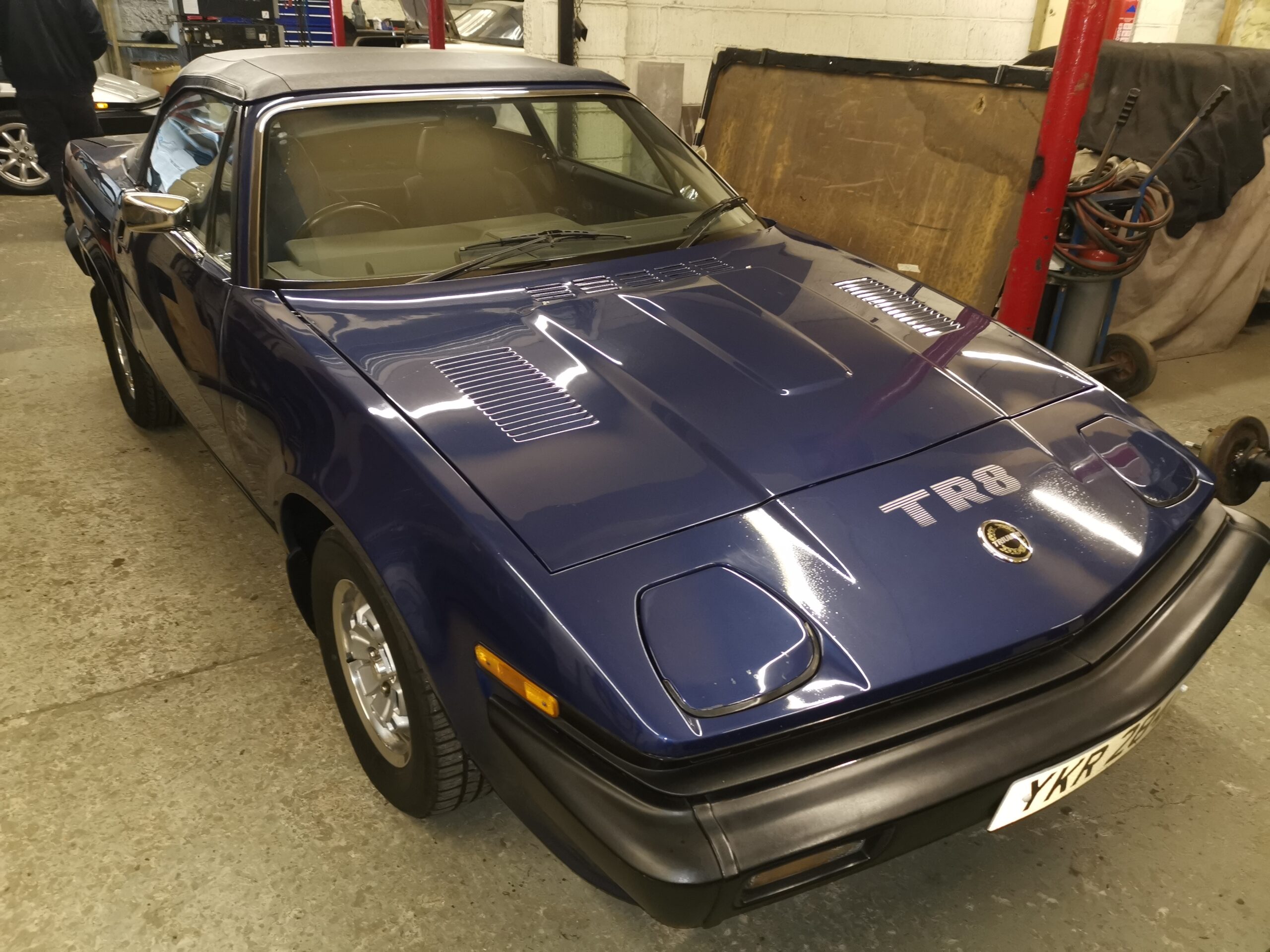
Did the factory Convert USA LHD TR8’s to RHD steering?
Triumph TR8 RHD vs LHD | Factory Conversion Myths – Many owners claim that their USA-spec LHD TR8s were converted to RHD by Triumph.
Potentially one of the main reasons for this assertion, is that such cars typically command a higher value, being seen as the next best thing to the 22 factory-built RHD UK SPEC TR8s, along with the three RHD EXP TR8s that the factory actually produced in RHD.
In addition, being RHD in a RHD market naturally improves resale prospects, while also adding an air of credibility and desirability, the suggestion that the car is a “special development vehicle converted to RHD by Triumph” further enhancing its appeal and value.
Short Version
Answer: NO
Why?
- The Measham and EXP test car disposal records show all the LHD USA-spec cars were sold as left-hand drive. Not converted to RHD by the factory as claimed by some owners.
- Early original owners of claimed converted cars, confirm the cars were originally purchased as LHD.
- Converting a TR7 or TR8 is not practical: unlike earlier chassis-based cars where its a very simple, stick the steering column in a different hole that’s already there, they use a handed monocoque body that requires cutting out and replacing the entire bulkhead, a process taking around 10 days. This makes conversion uneconomical both in time and cost. Re-shelling/building in to a RHD shell (1–2 days) was far more viable, and there are a few examples of the factory actually doing this.
- Anecdotal evidence from people involved at the time indicates no known conversions were ever carried out.
Long Version
This is, to a very large extent, an old wives’ tale. Triumph would never have invested the enormous time and resources required to convert completed cars to right-hand drive. This is especially true of the TR7 and TR8: unlike the earlier TR models, which were relatively straightforward to convert, each TR7/8 bodyshell was manufactured as a specific handed version from the outset.
To understand why this is the case, it is first necessary to appreciate what is actually involved in converting a left-hand-drive TR8 to right-hand drive. The following section therefore sets out, in detail, the full scope of such a conversion.
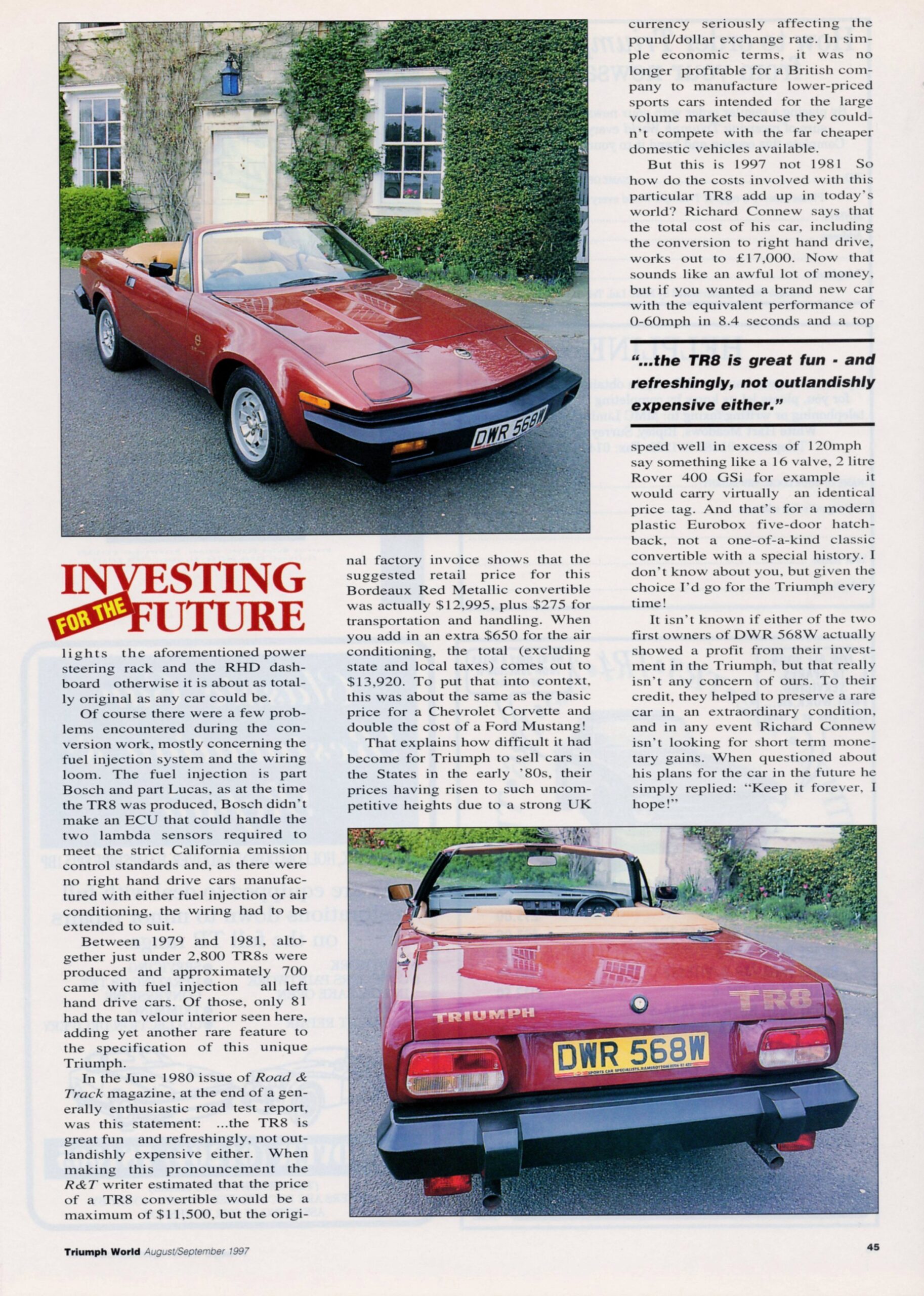
My red left-hand drive TR8, which had covered just 600 miles from new, was converted to right-hand drive in 1997 by Steve Wilcox of S&S Preparations. I am grateful for his assistance in the preparation of this section describing the conversion process.

Engine bay and front end
- Remove the engine and gearbox together with the exhaust up to just after the centre boxes. Ideally, remove this as a complete assembly with the front suspension and subframe, as this provides easy access to the centre brake pipe and allows the steering rack to be swapped.
- Remove the radiator to gain access to the area where the brake pipes and wiring run.
- Remove the wipers and the lower windscreen trim.
- Remove all brake pipes, the brake and clutch master cylinders, wiper motor, washer motor, cables, and virtually all components in the engine bay, particularly from the suspension turrets rearwards.
Interior
- Remove the seats, sun visors, sill carpets (ideally all carpets), dashboard, and heater. This is necessary to access the heater/column mounting bracket, which is handed and must be replaced.
- Remove the complete steering column assembly.
- Remove the main wiring loom and rear loom, as these must be inverted to run on the opposite side.
- Remove the bulkhead soundproofing.
Body modifications
- Cut out the bulkhead sections that are to be replaced. Weld in the new panels and finish them ready for paint.
- Remove the battery tray and wiper motor tray and fit new right-hand-drive (RHD) versions.
- Paint the bulkhead and, most likely, the area to the rear of the suspension turrets.
Note: This area is where the conversion is most visible. Common tell-tales include the left-hand bulkhead still showing the throttle pedal indentation and the steering column hole remaining on the left-hand side.
Reassembly
- Once painted, refit the wiring looms in their new RHD orientation, along with the RHD heater mounting and steering column support. All other column components remain the same.
- Refit the sill carpets, dashboard, and seats. Note that the sun visors are handed and must be replaced, as must the switch panel description strip.
- Rebuild the engine bay using the original clutch and brake master cylinders, but fit new brake pipes and a new clutch pipe.
- Refit the wiper and washer motors, along with a new RHD lower windscreen trim and RHD wiper arms. The washer pipe will need to be rerouted through the opposite inner wing.
- Swap the steering rack to the RHD unit.
- Reinstall the engine and gearbox onto the subframe and refit the complete assembly to the car.
- Replace the headlight units.
- Reconnect all systems, including fitting new cables where required.
There is a minimum of 80 hours’ labour involved in completing all of the above.
This may not be absolutely exhaustive, but it covers the bulk of the work involved.
Parts List
- Steering rack
- All brake pipes (except those across the axle)
- Clutch pipe (as required)
- Bulkhead repair panels
- Lower windscreen trim (RHD)
- Wiper arms (RHD)
- Sun visors
- Switch panel description strip
- Steering column support bracket
- Heater support bracket
- Throttle cable
- Choke cable
- Speedometer cable
- Headlight units
- Battery tray and wiper motor tray
- Bulkhead soundproofing
There will likely be a few ancillary items not listed above.
Conclusion
The factory is exceedingly unlikely to have gone to such lengths given the time and cost involved. This is supported by the Measham disposal lists, which show that the factory LHD USA-spec exp/test cars were sold as LHD.
Who did the conversions?

The fact that Mark Grinnall offered left-to-right conversions speaks volumes; such a service would not have existed without clear demand. A growing number of first owners have since confirmed that their cars were converted by Mark.

LVC359V was used as the PIRELLI test car USA spec LHD now advertised as RHD!
Research
Many years ago, Roy Ford (formerly of Triumph Experimental) rescued an extensive archive of factory records from being discarded and passed them to David Pearson of Canley Classics. These records relate to the final stages of TR7 and TR8 development at Canley.
The archive primarily consists of internal factory memoranda concerning the experimental fleet, covering the period from October 1979 through to the fleet’s breakup and disposal in the summer of 1981. Included within the collection are Measham disposal records dating from June 1981, as well as individual vehicle disposal sheets detailing each car’s specification, condition, and method of disposal.

This confirms X919 was ORIGINALLY sold as LHD. It is an excerpt for the June 1981 disposal records confirming it was sold as LH.
See David’s web page concerning those records here https://www.canleyclassics.com/?archive=tr7-tr8-experimental-records Recent research based on these records confirms that factory left-hand-drive exp/test TR8s were all sold as LHD vehicles and were not converted to RHD by the factory.
What did the factory do if a RHD TR8 was required?
There is one known example of a RHD V8 at the Measham auctions: EKV397T. This car was painted in rally colours and used by BSM for their advanced driving courses. In effect, it is a TR8 built into a RHD TR7 TCG shell. There is also another example XGJ695S not in the Measham auctions, but used by LUCAS for EFI testing and again it uses a RHD TR7 shell.

For a new car, with all components secured by easily removable bolts, swapping the necessary parts across would have been a one-day job if everything had been prepared, as in front suspension engine and subframe assembly ready to fit for example . This was considerably quicker than converting a LHD car to RHD, which typically took around 80 hours (approximately 10 days). This from the research done suggests if they did anything Triumph would almost certainly have used a RHD shell.
How were ex factory cars sold/left the factory
Measham Auction August September 1981
Measham is the most well known external disposal auction where the vast majority of the TR8’s were sold.
Internal New car sales scheme
Senior employees could buy them new from the internal car scheme – more often than not those owners then sold them privately to owners outside the factory.
Used Internal Factory Vehicle Sales Process
From time to time, the manufacturer disposed of vehicles that were no longer required for internal use. These typically included ex-management fleet cars, press department vehicles, and experimental or pre-production cars. Rather than selling these externally, the company made them available exclusively to factory employees.
A dedicated internal department managed these sales. Vehicles were assembled in a designated parking area within the factory grounds and offered in scheduled sales events. Each sale generally consisted of a limited selection—typically in the region of 20 to 30 vehicles.
The sales operated on a first-come, first-served basis. No advance reservations were taken. On the day of the sale, employees wishing to purchase a vehicle were required to attend in person, and demand often exceeded supply. As a result, prospective buyers commonly queued from very early in the morning to secure their preferred choice.
Once admitted, buyers selected from the available vehicles in order of arrival and completed the purchase directly through the internal sales department. This process allowed employees to acquire well-maintained, low-mileage vehicles with known histories, while providing the company with an efficient and controlled method of vehicle disposal.
The O series TR7’s were stripped of their engines and sold to employees so it is likely they were sold as rolling shells via this process.
Parts Cars – Unofficial
These were often cars that had been officially scrapped and sent to other departments for cannibalisation, but somehow managed to leave the factory gates late one night. In most cases, the only identification remaining on these cars was a body number, so many were registered using that number, as they no longer had chassis numbers.
The converted to RHD TR8’s below may/have/had stories suggesting the factory converted them to RHD.
1 – EXP X919 PENDELICAN WHITE – JVC824V – Engine 13E00114 (EFi) – AUTO – Body number BAP100189 (1980/81) SPEC – Blue check Trim) EXP TR8. USA spec 8:13 pistons

This confirms this car X919 was ORIGINALLY sold as LHD. It is an excerpt for the June 1981 disposal records confirming it was sold as LH.
2 – TPZDV8AT 203169 PENDELICAN WHITE now but was originally Triton Green – LVC358V – Engine 14E00002 (EFi) – MAN – Body number BAP207201 (1980/81) SPEC – Blue check Trim Designated general Development TR8. USA spec 8:13 pistons
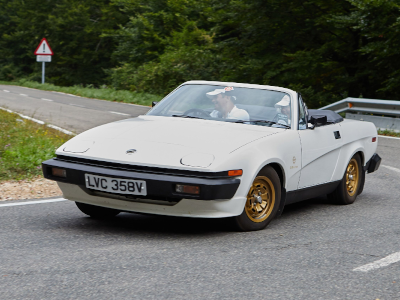

LVC358V – confirmation the car was converted
3 – TPZDV8AT 201675 PLATINUM SILVER – KHP533V – Engine 15E00002 – AUTO – Body number BAP207721 (1980 )SPEC – Blue Velour Trim but originally blue check) Designated possibly press or general use pool car for BL employees Auto TR8. USA spec 8:13 pistons.
This car has no record at all of ever being converted from LHD to RHD nor did it ever exist as a press car or known test, development or EXP car in any lists available. It may have been kept for legal protection for the USA automatic TR8 market.
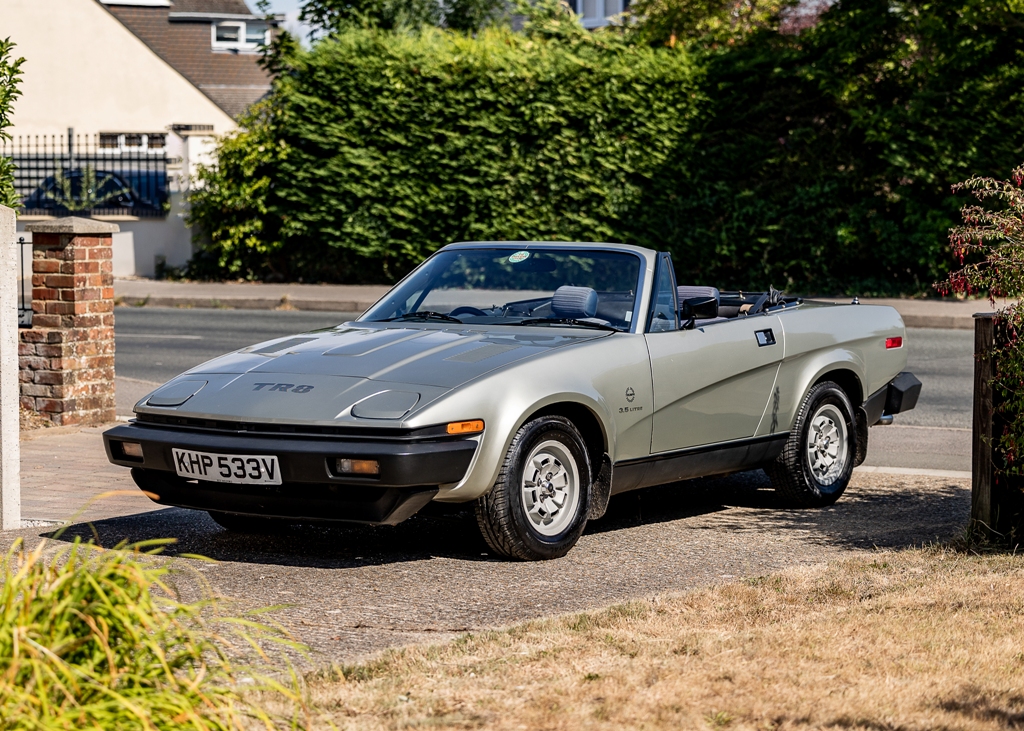
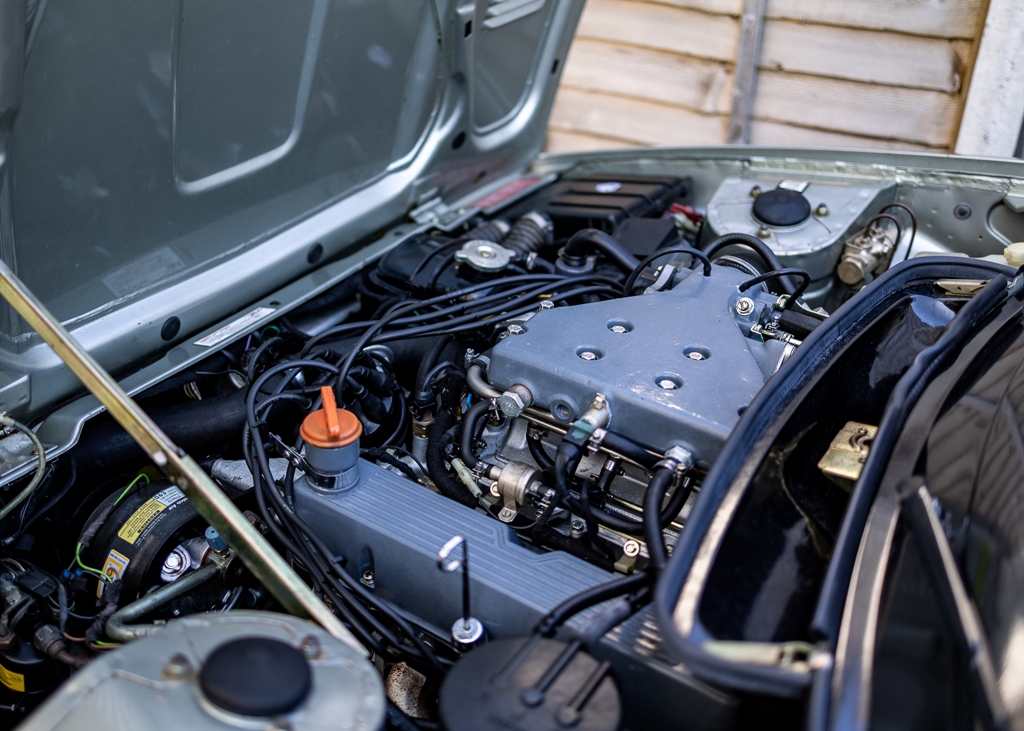
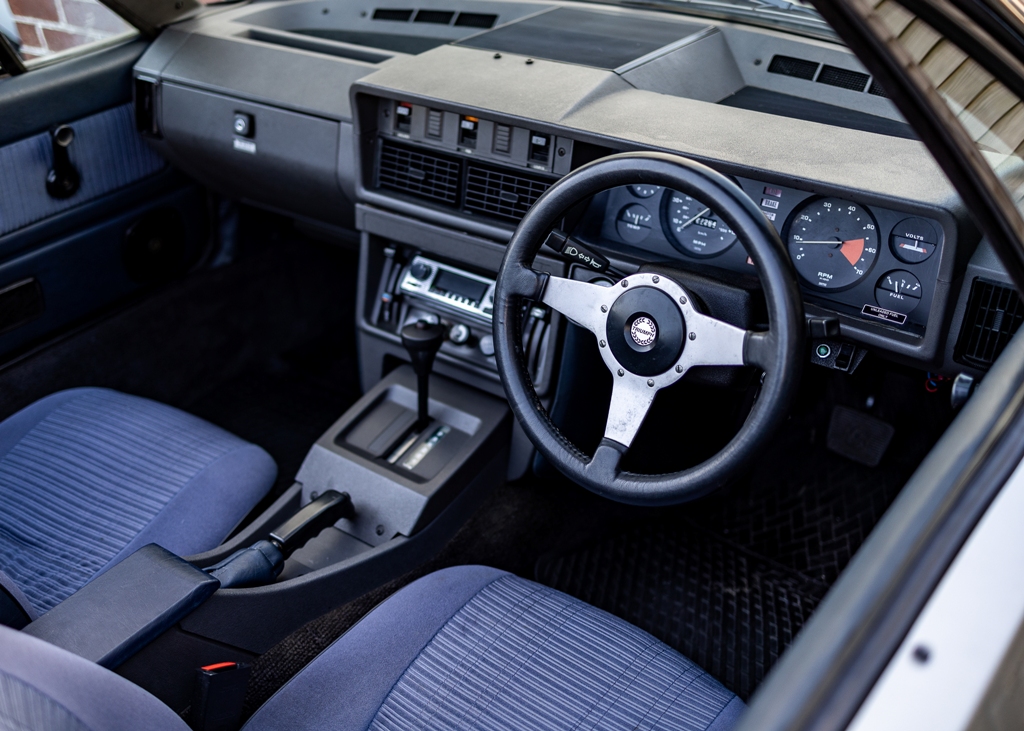

Sold at Auction September 2022 – close to 25K
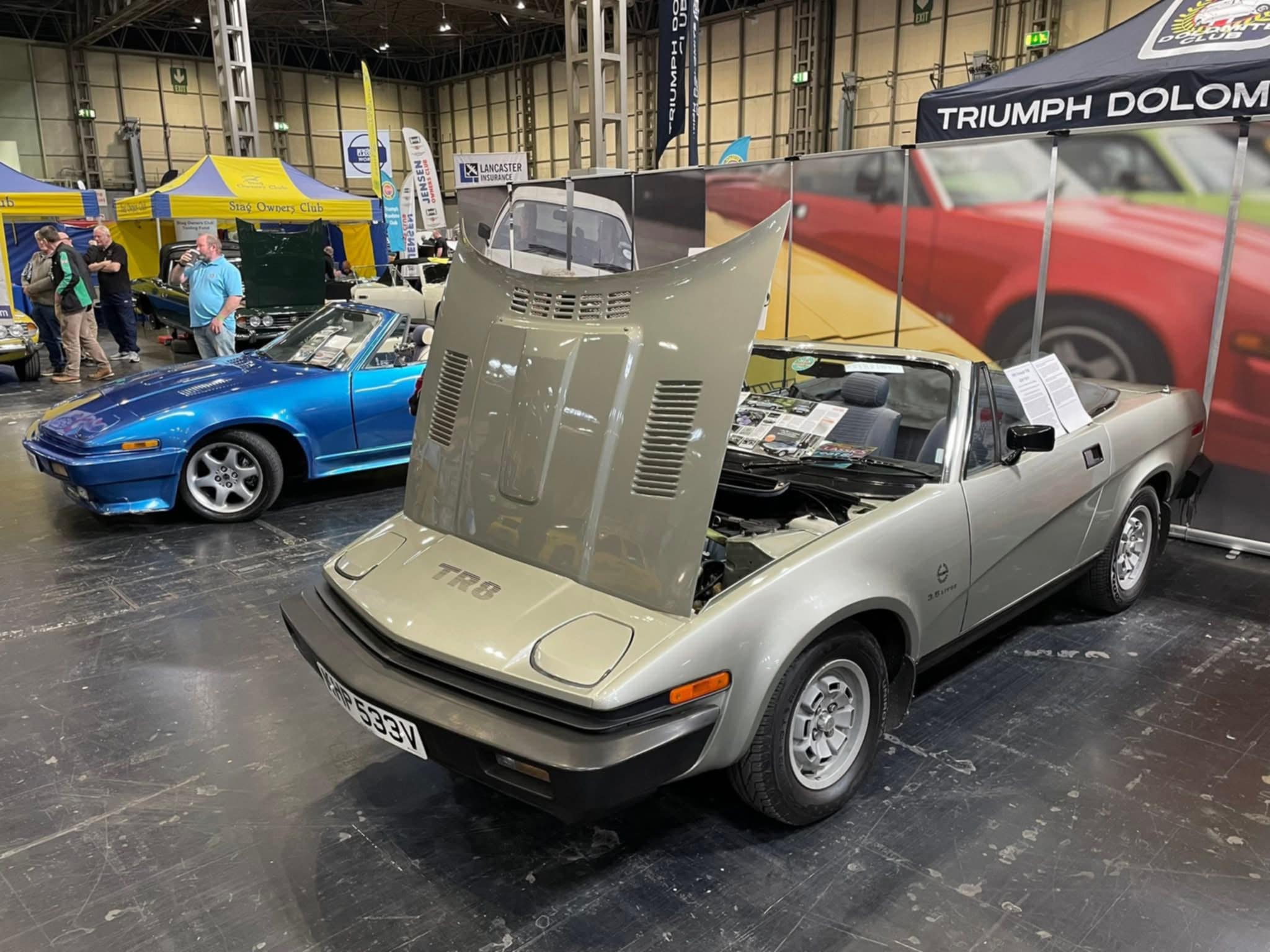
KHP533V on display on the TRDC stand at the NEC 2026
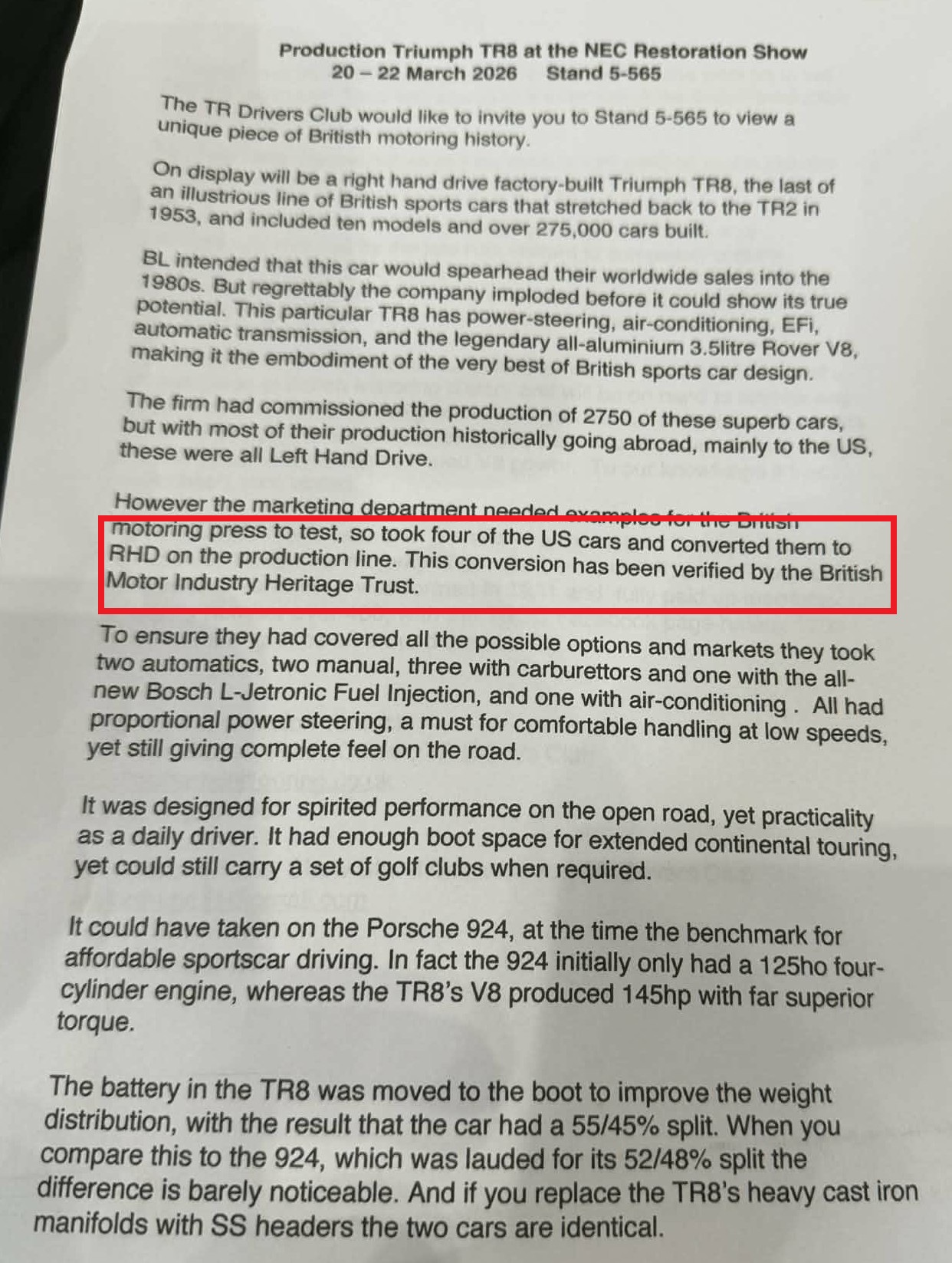
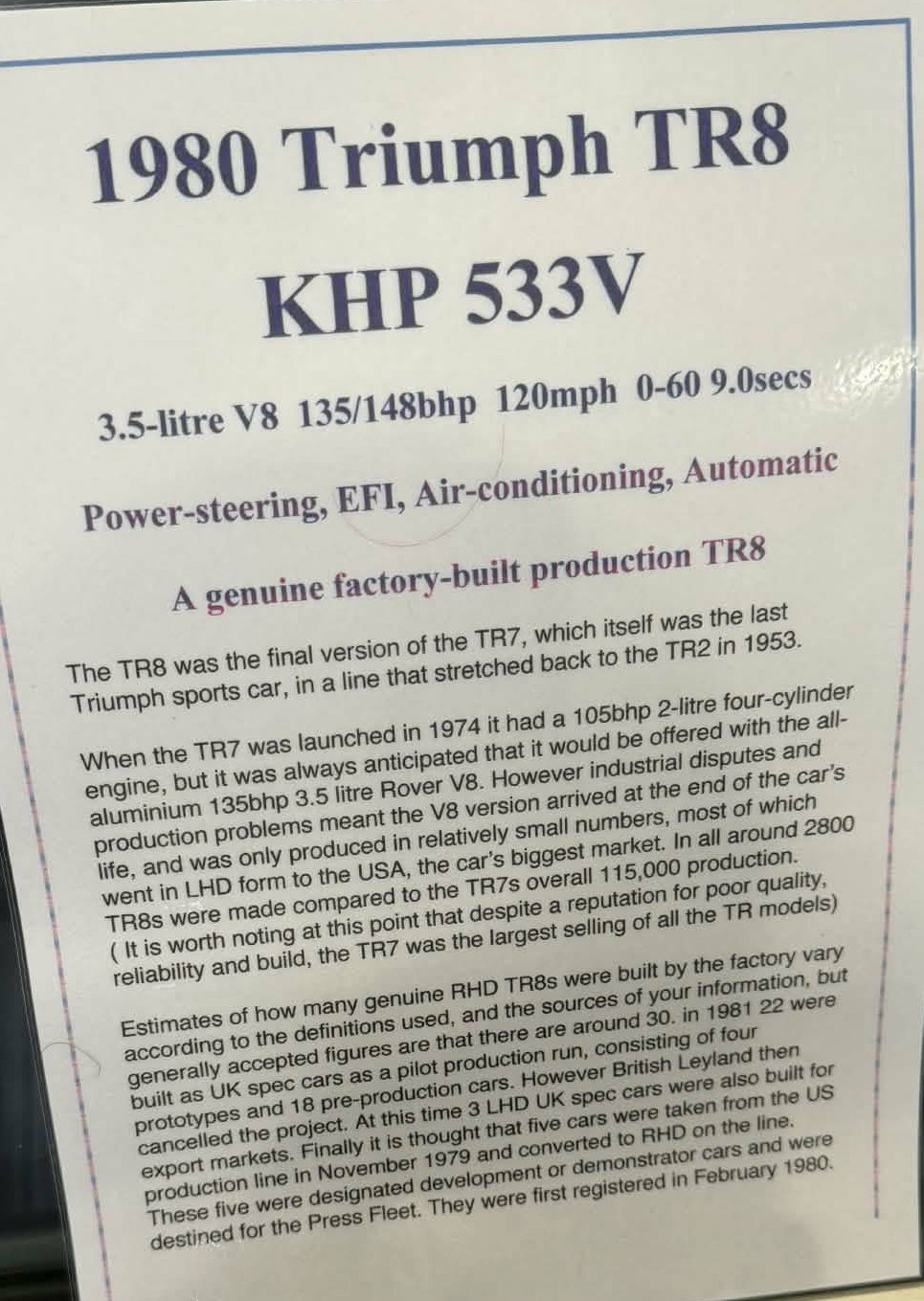
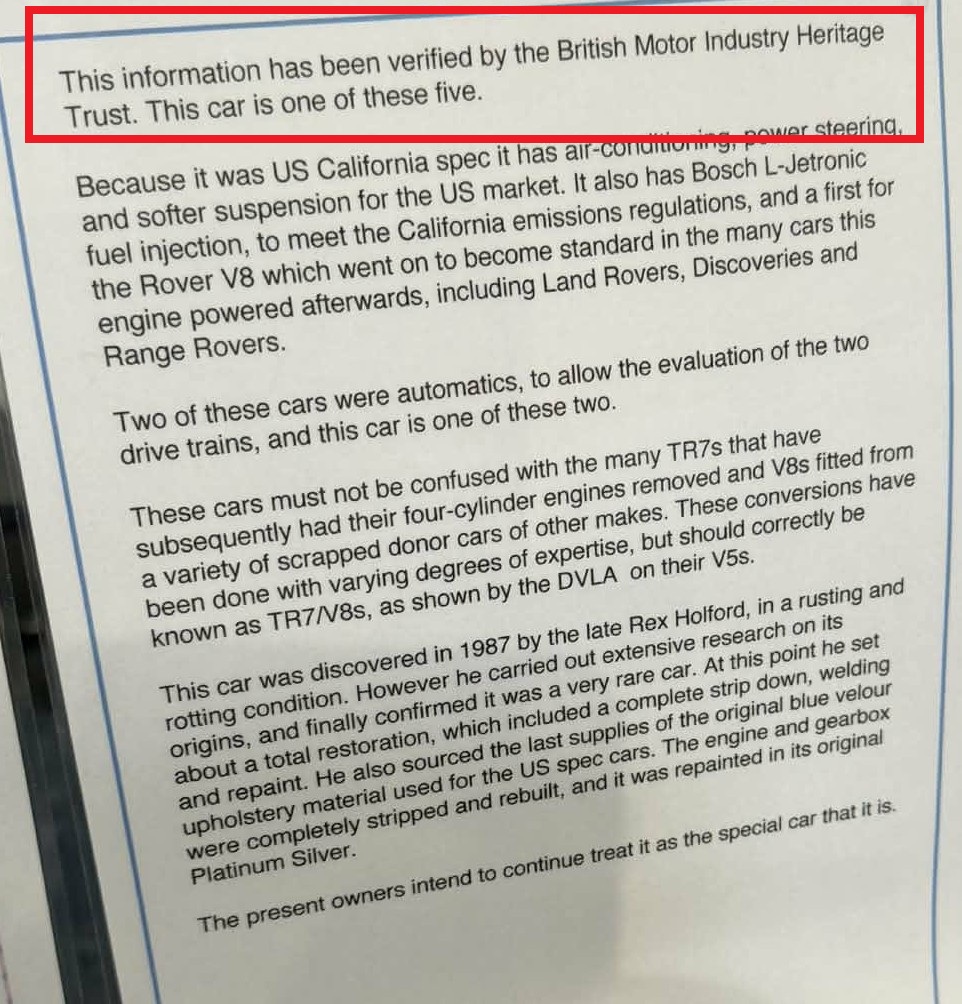
Incorrect/untrue information added to KHP533V’s show sheets claiming Heritage approval which was certainly not the case. The only actual approval if you can call it that, was from Dr Christopher Kenneth Smith Archivist for the TR Register as is shown in the other information excerpt below (as confirmed by the TR Register). So no Heritage approval at all.

Incorrect/untrue information added to the cars heritage certificate in 2024/5 at the insistence of the owner at the time and Dr Christopher Kenneth Smith Archivist for the TR Register.
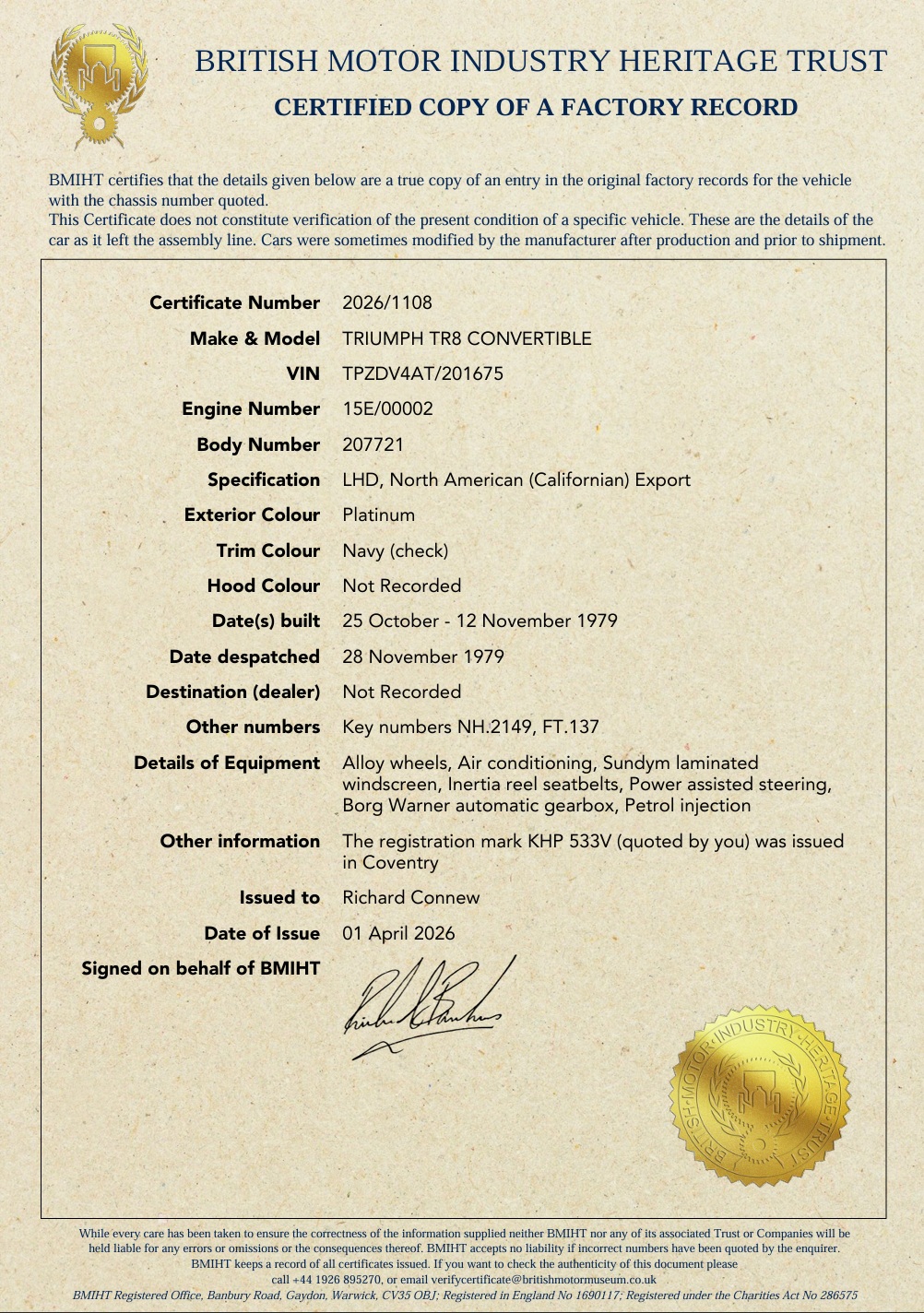
I proved there was no evidence whatsoever behind the comments previously added to the Heritage certificate and Heritage apologised for allowing them on in the first place and removed them. This is the cars current and correct certificate. It was never converted by the factory nor was it ever anything to do with the RHD TR8’s. It is likely it was a legal car retained as an auto example and or a management car but there is no proof of anything other than what the certificate states above.
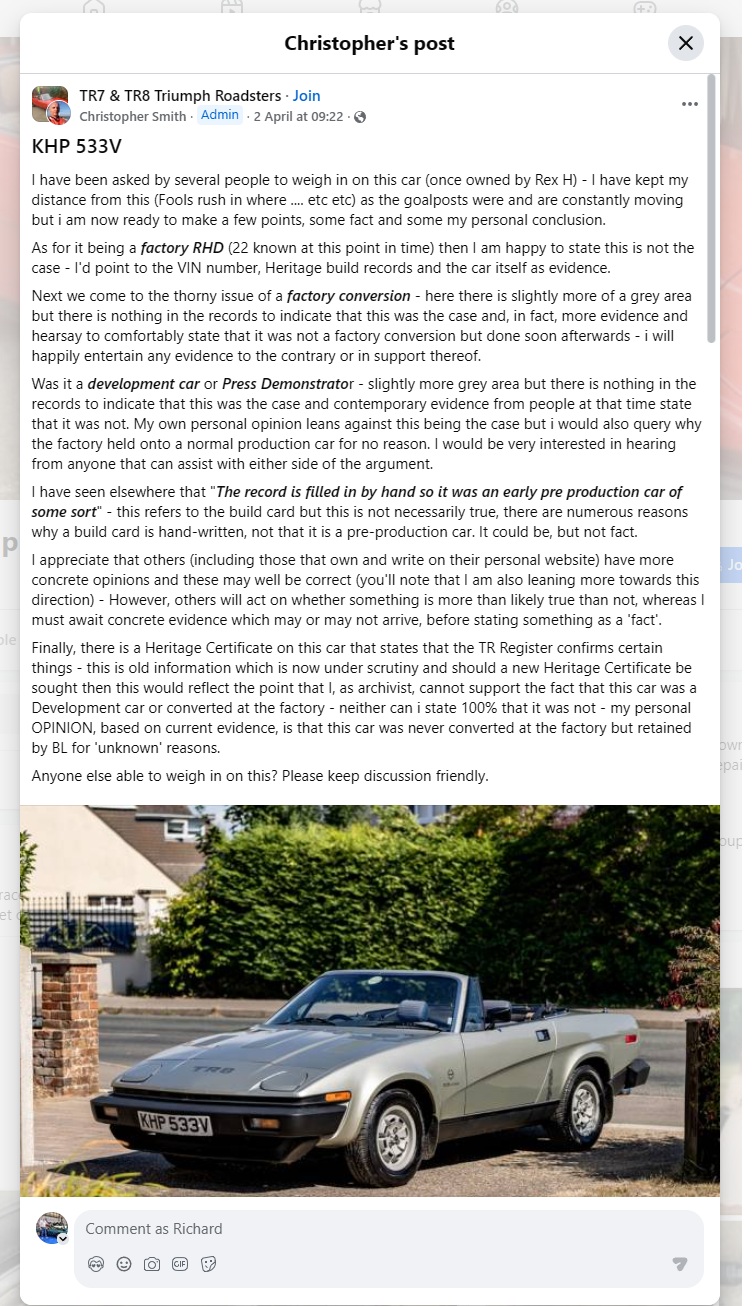
Dr Christopher Kenneth Smith Archivist for the TR Register. retracted his original thoughts on the car.
4 – TPVDV8AT 212236 PENDELICAN WHITE – MVC128V – Engine 14E0000? (EFi) – MAN – Body number BAP? (1980/81) SPEC – Tan check Trim Designated TR8. USA spec 8:13 pistons

MVC128V – confirmation the car was converted
5 – TPVDV8AT210006 PLATINUM SILVER – TVC59W – Engine 12E01056 – MAN – Body number BAP213577 (1980) SPEC – Tan check Trim) Designated TR8. USA spec 8:13 pistons
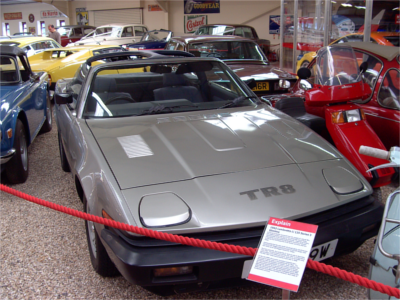
TVC59W – Known conversion to RHD and 2+2 by Preston’s Garage after being initially sold
6 – TPzDV8AT201479 POSEIDON GREEN – KDU315V – Engine 14E00009 – MAN – Body number BAP297586 (1980) SPEC – Tan check Trim) Designated TR8. USA spec 8:13 pistons
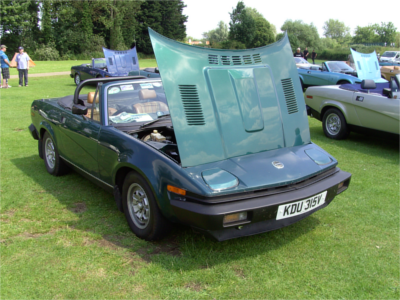
KDU315V – No confirmation for this one but the conversion on the car would appear to confirm it was converted
7 – TCV20017UCF PLATINUM SILVER – KHP565V – Engine 13E00184 – MAN – Body number BAP204984 (1980) SPEC – Tan check Trim) Designated Experimental – Fitted with UK spec engine TR8. USA spec 8:13 /9:35 pistons?
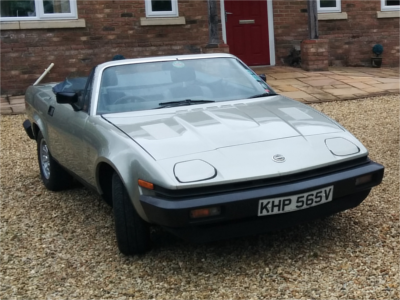
KHP565V – Sold at Measham 14/8/81 as LHD

KHP565V – confirmation the car was converted
8 – TPVDV4AT 207723 CASHMERE GOLD (Heritage say RUSSET BROWN) – LVC365V – Engine 13E00311 – AUTO – Body number (Heritage say 212740 LHD – On car now BBP203123 RHD) (1980) SPEC – Tan check Trim Designated experimental Auto TR8. USA spec 8:13 pistons. Believed re-shelled to RHD by whom not known currently.
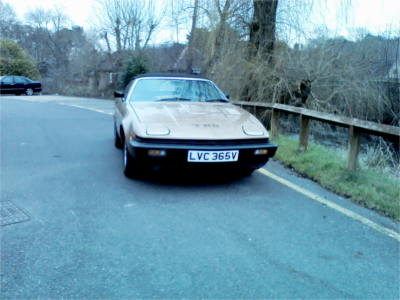
LVC365V – This car could be an example of re-shell to RHD as it started life as Russet Brown LHD shell and is now in a Gold RHD shell.
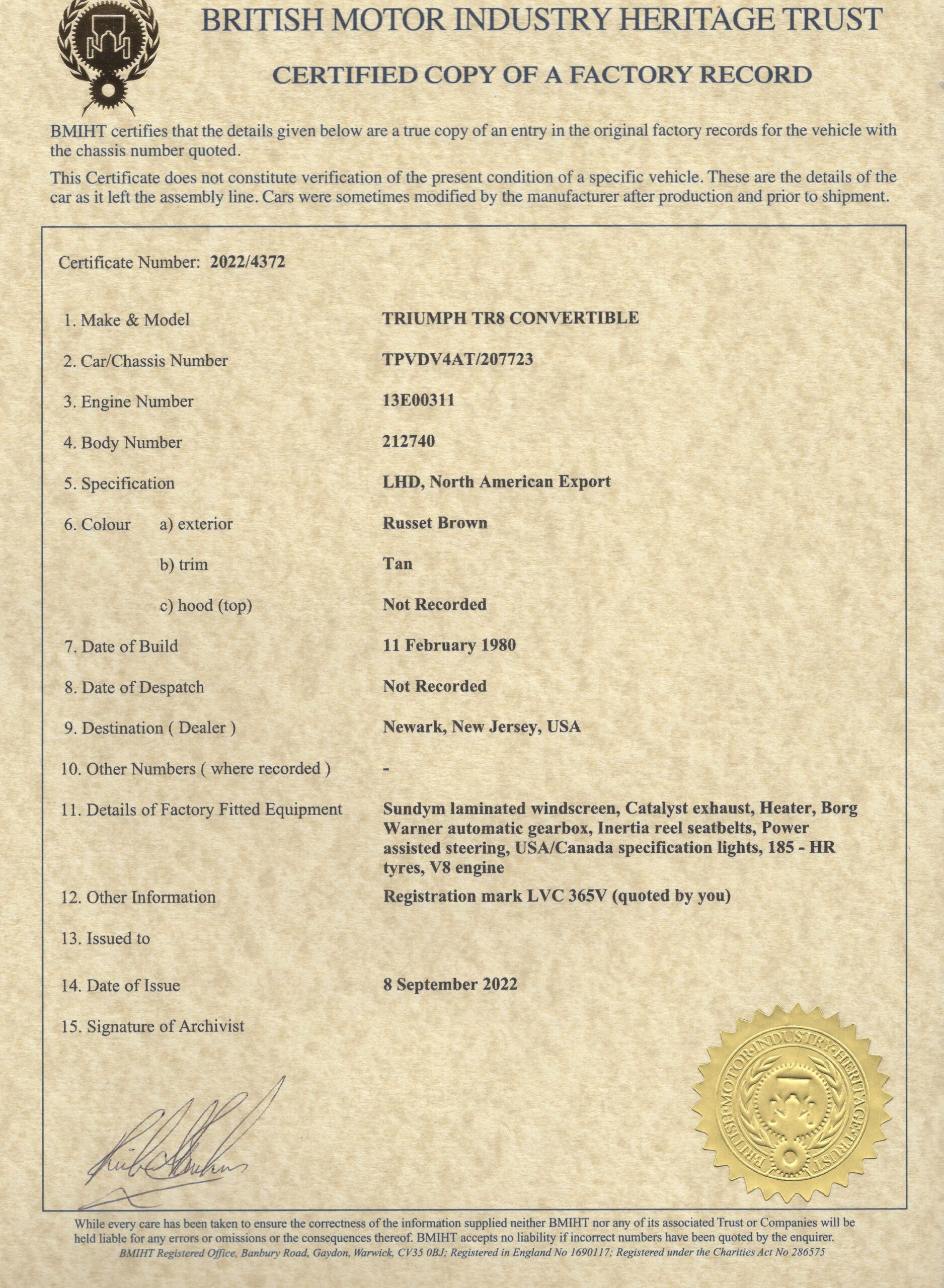
LVC365V – Possibly a RE-SHELL but not known by whom
FACTORY USA SPEC TR8’s THAT HAVE BEEN CONVERTED OUTSIDE THE FACTORY TO RHD
These cars have been converted to RHD by their owners after they left the factory. Most of these cars are well known and have been the subjects of excellent Left to RHD conversions, such that for many, you cant tell they were ever LHD.
1 – SATTV4584BA 208267 BORDEAUX RED – DWR568W – Engine 14E00545 – MAN – Body number? (1981) SPEC – Tan Velour Trim) Very nicely Converted RHD by S&S Preparations. USA spec Efi 8:13 pistons
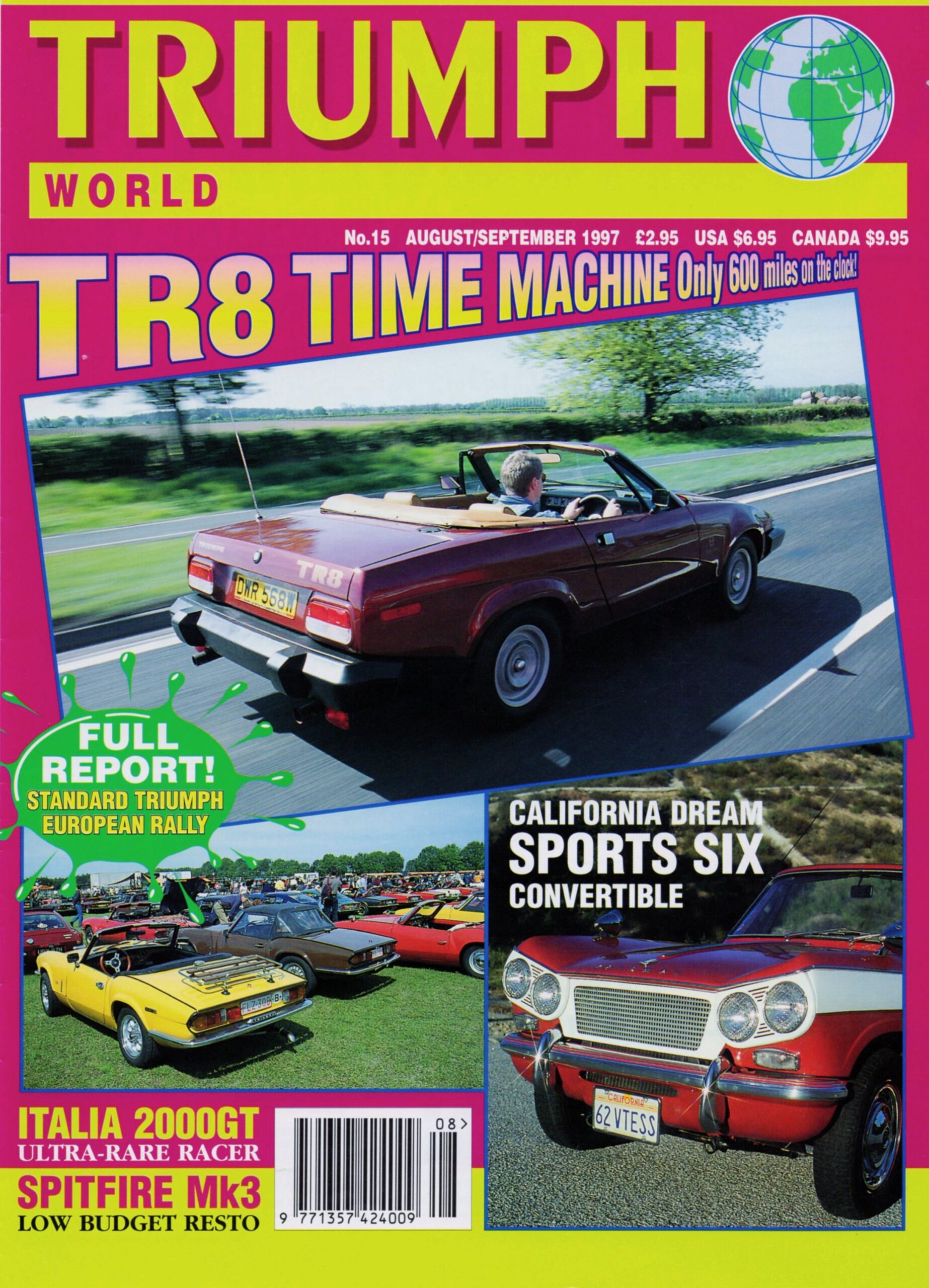

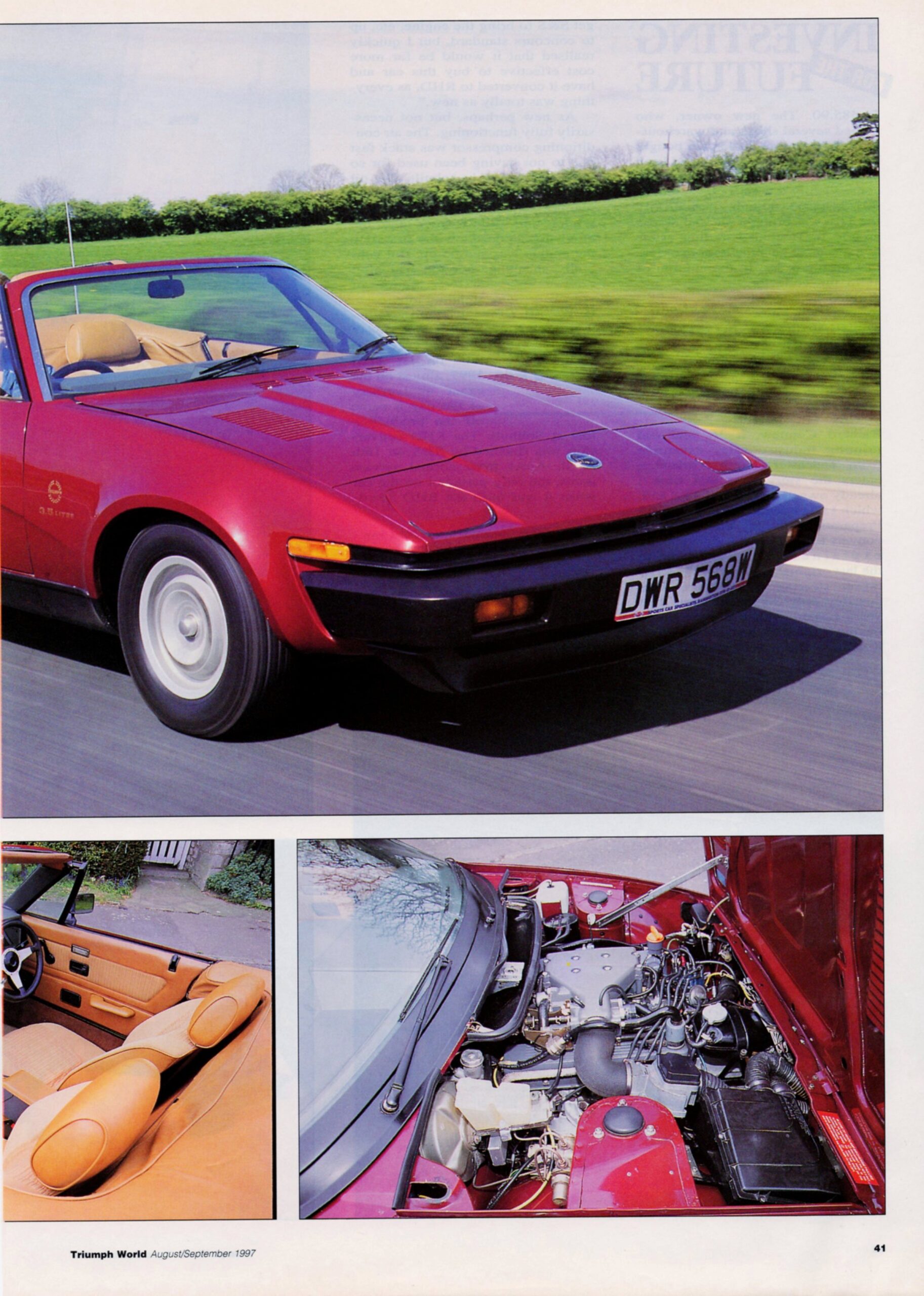
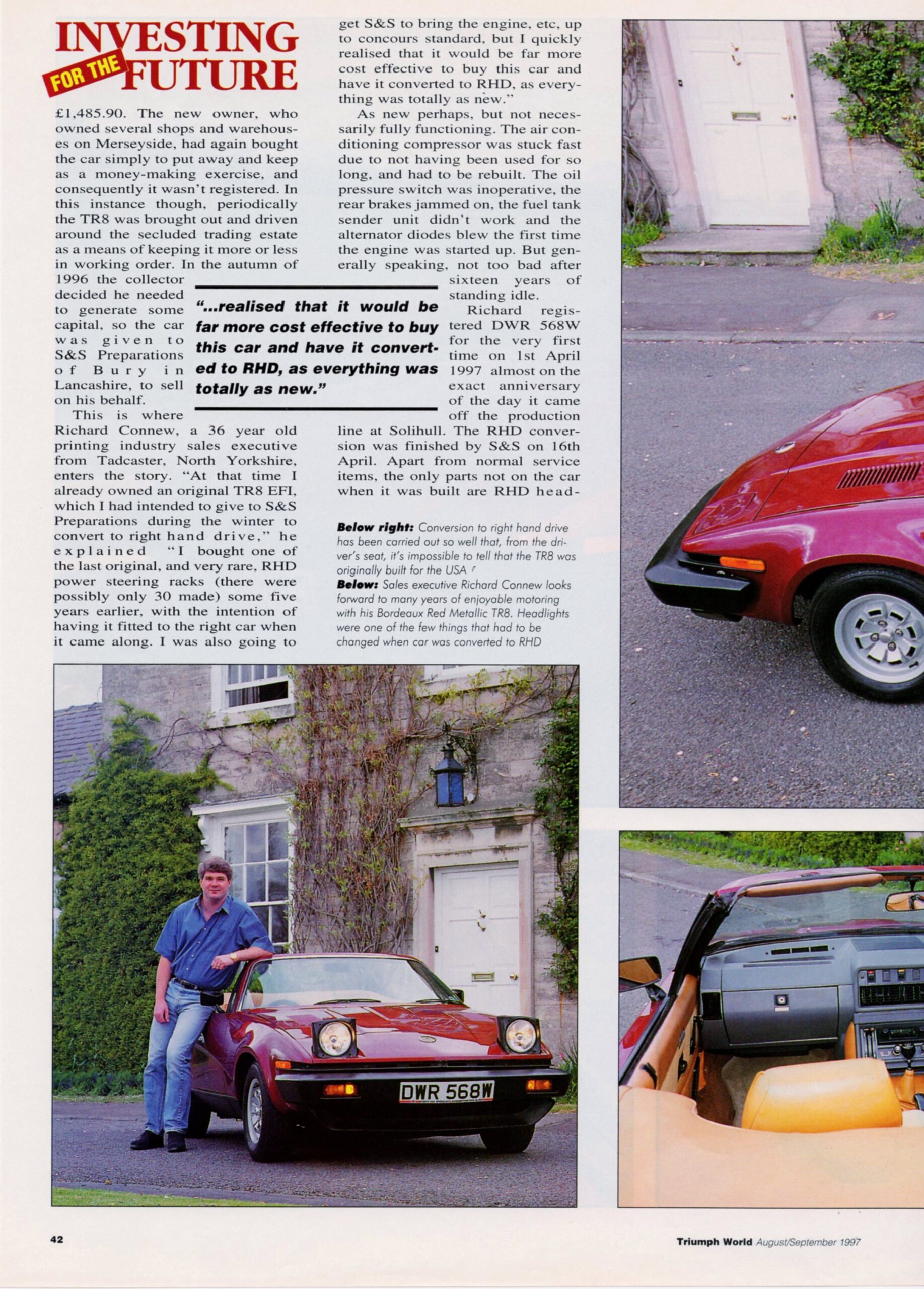
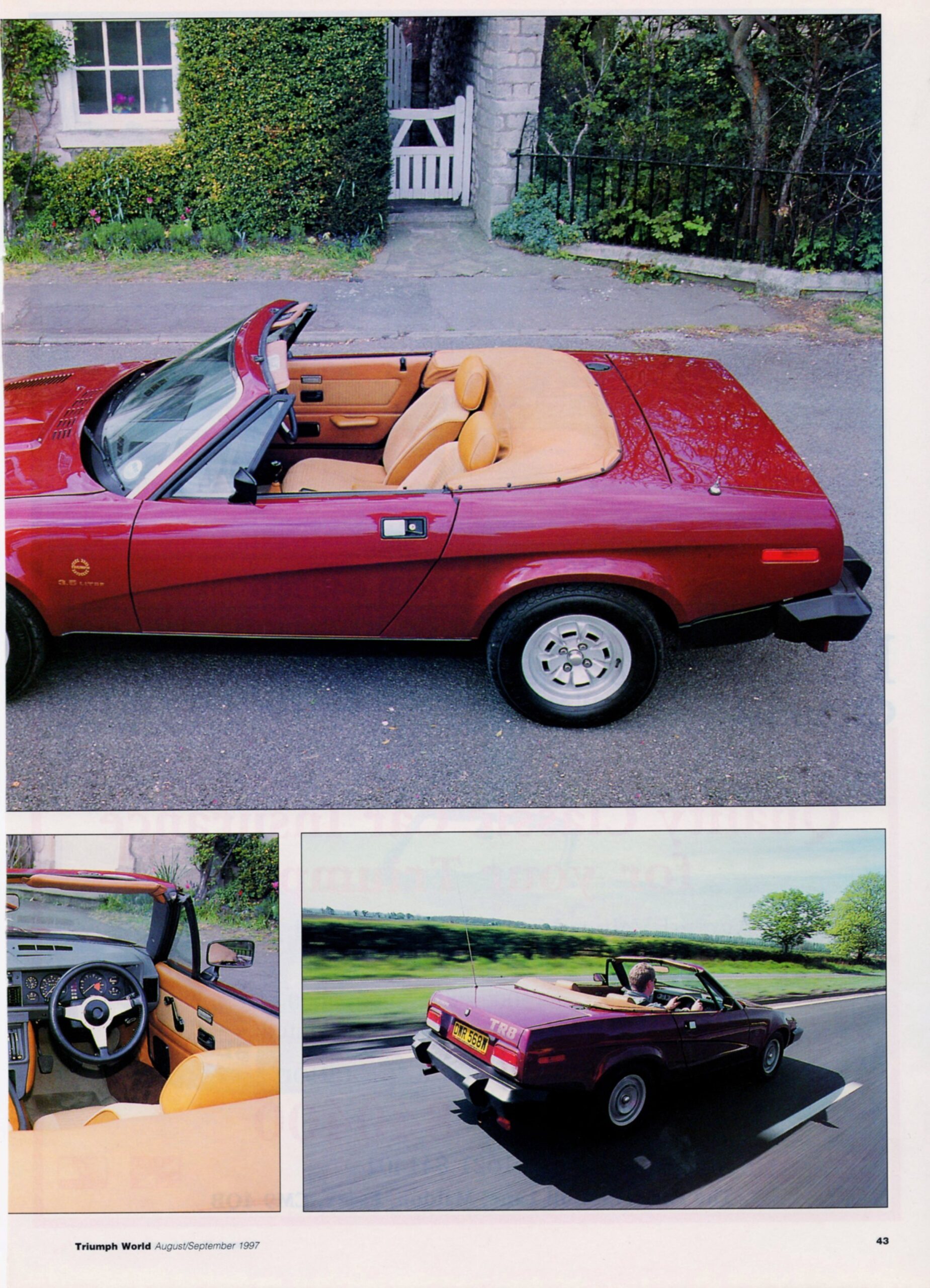
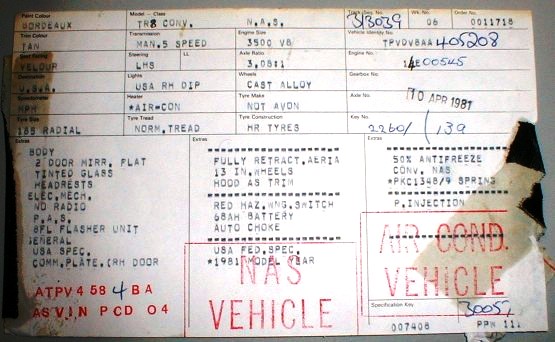
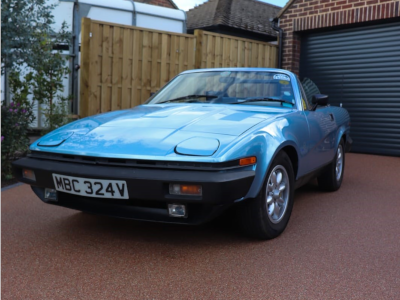
2 – TPVDV8AT208267 PERSIAN AQUA – MBC324V – Engine 12E00627 – MAN – Body number BAP210433 (1980) SPEC – Tan check Trim) Converted RHD by TR GB. USA spec 8:13 pistons
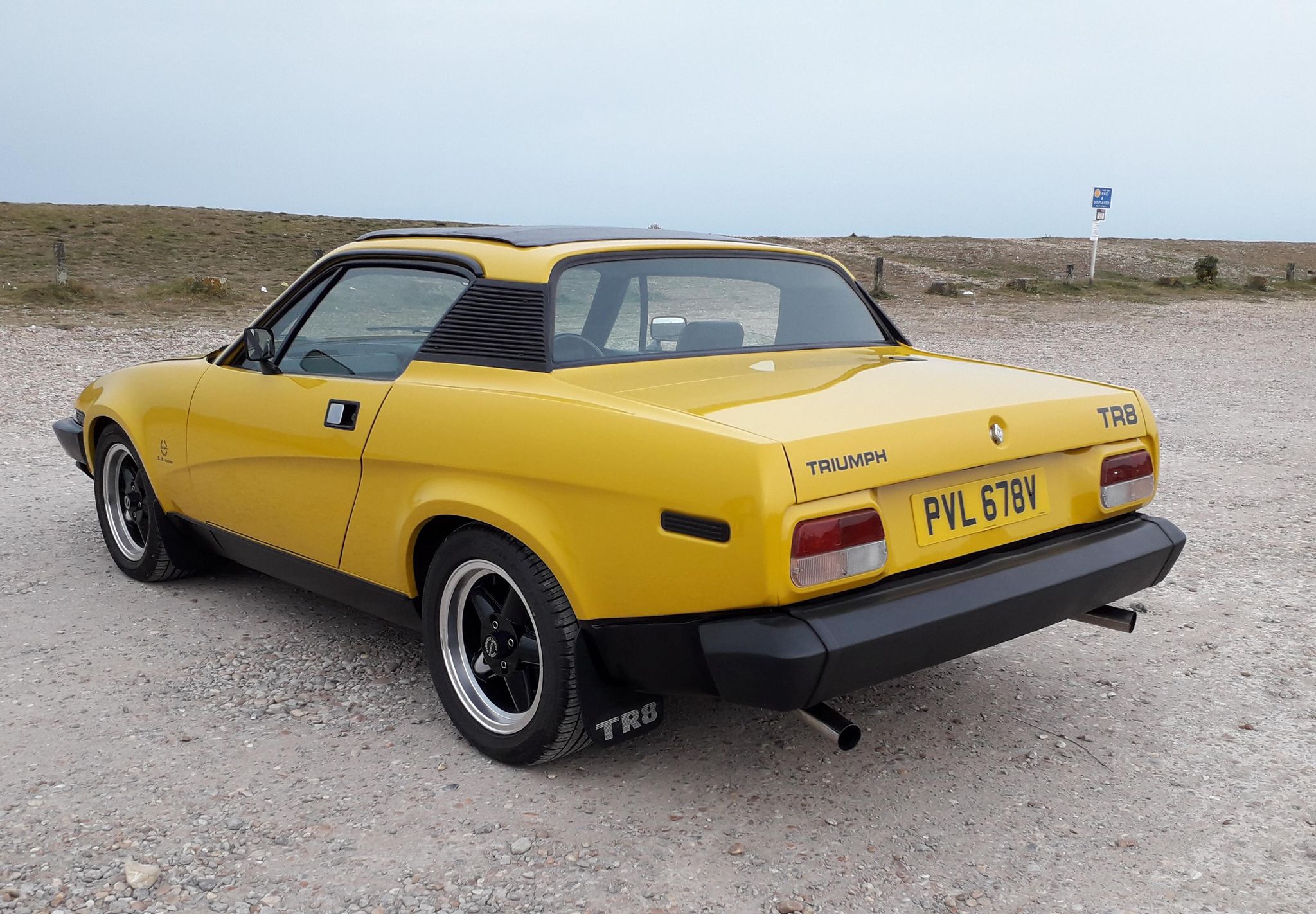
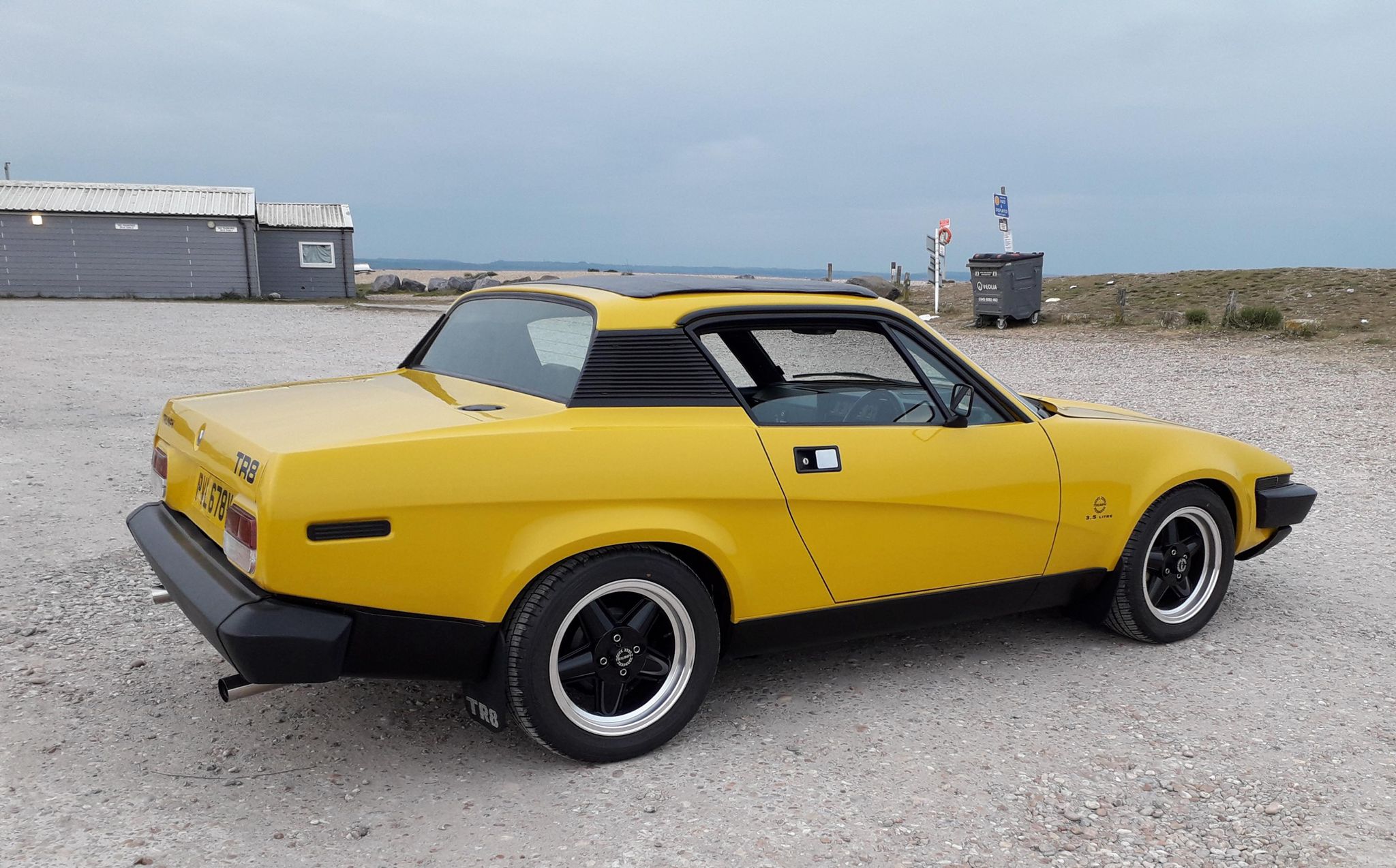
3 – TCN160128UCF INCA YELLOW – PVL678V – Engine 12E00690 – MAN – Body number? SPEC – Green check Trim) Converted to RHD by Andy Salter USA spec 8:13 pistons, now uprated to 9.35 pistons.
TR7/NEW BUILD TO TR8. WELL BUILT NON ORIGINAL FACTORY TR8’s USING 95/100% FACTORY ORIGINAL PARTS.
These cars have been built to full factory TR8 spec but after production ended and by individuals so are not genuine RHD TR8’s but in every other respect are. Either from a donor TR7 or from a pile of new parts and brand new shell. Their builders/owners have always been genuine and above board about what they are. These cars represent the next best to an original factory RHD with some claiming they were much better built.
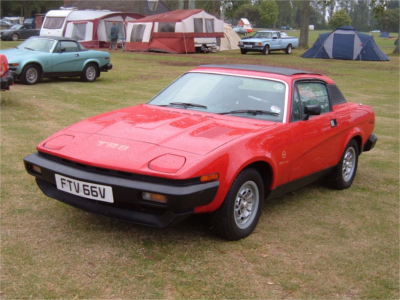
1 – TCG102447 CARMINE RED – FTV66V – Engine10A39511 – MAN – Body number N/A – (NEW SHELL BUILD) Built by Paul Towle to 100% RHD TR8 SPEC (Owned by Chris Turner currently)
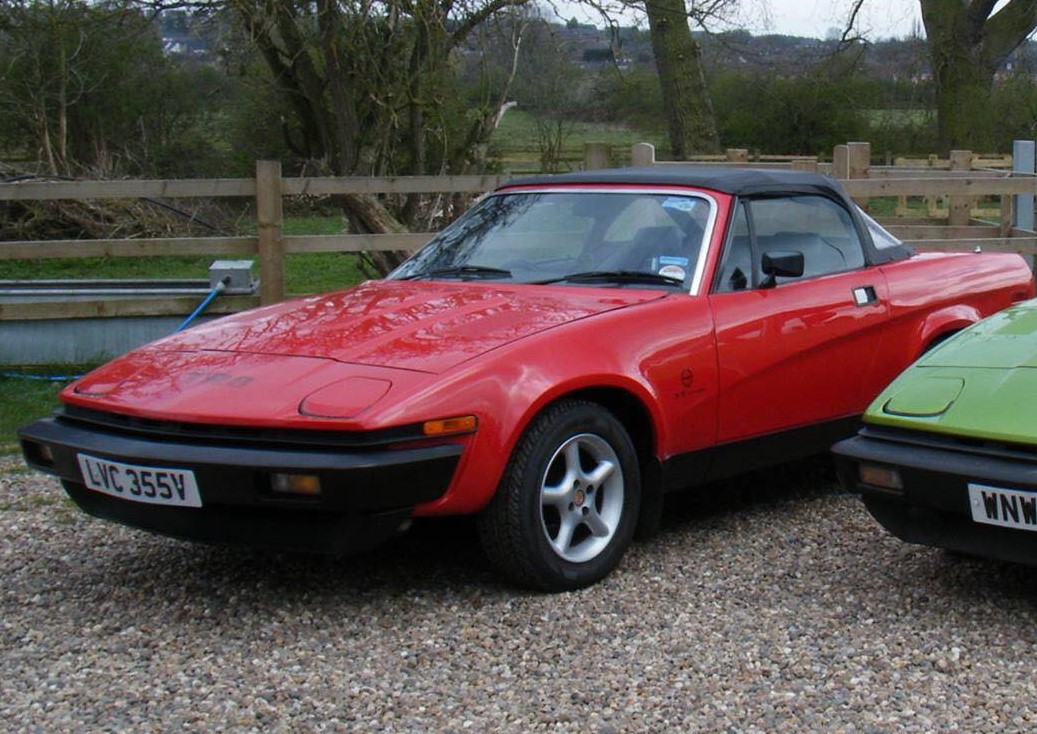
2 – TPZDJ8AT207163 CARMINE RED – LVC355V – Engine 12E00208 – MAN – Body number ? Built by Tony Butler to 100% RHD TR8 SPEC (Owned by Fin Purcell currently)
3 -SATTPADJ7AA407041 BLUE METALIC – YKR284X – Engine? – MAN – Body number ? Built by Brian Harber to 100% RHD TR8 SPEC